
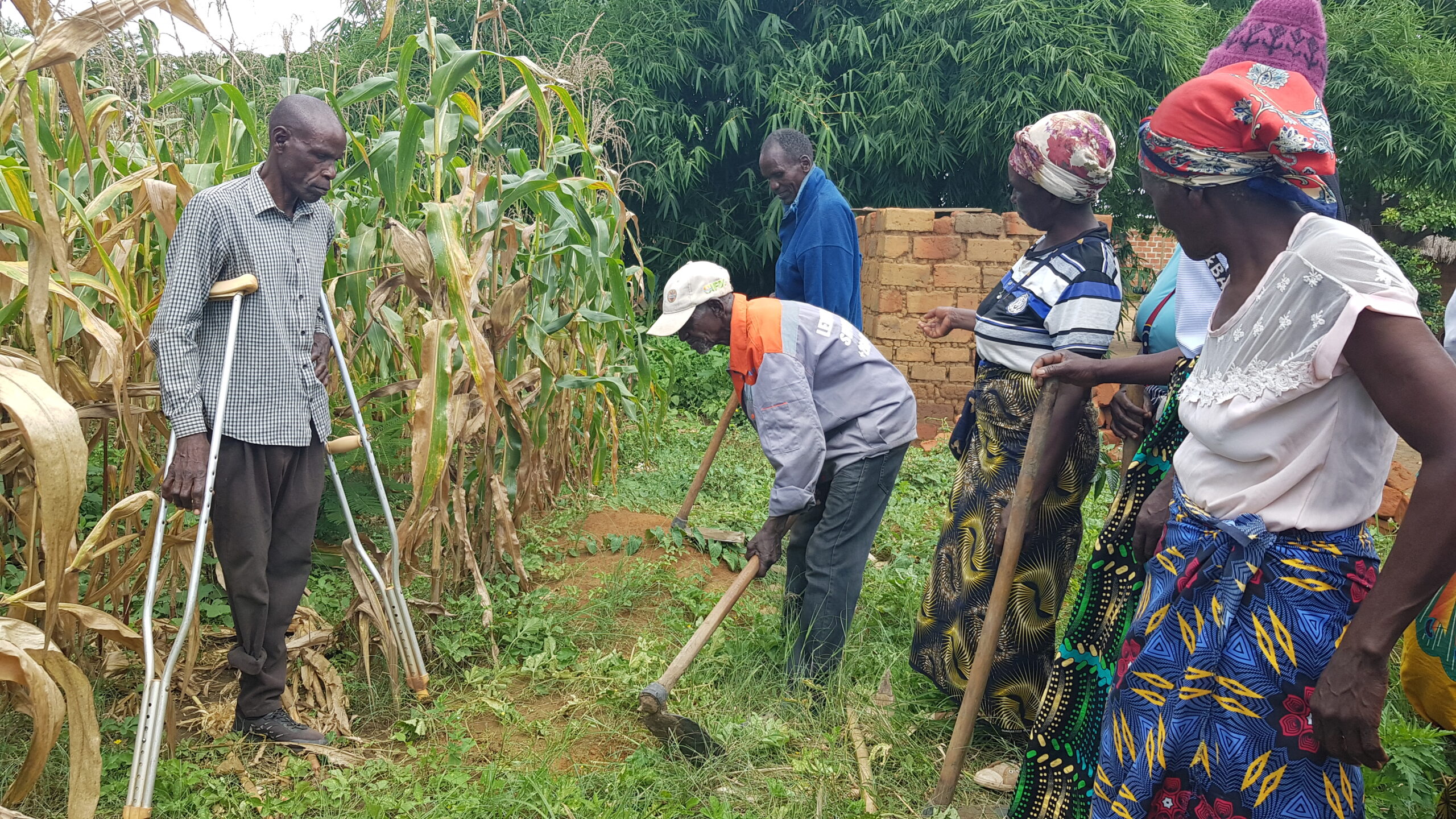
On 6 February 2026, we held an agroforestry training and tree planting demonstration with 21 smallholder farmers with disabilities in Kampekete Village, Chongwe District, where we planted treated Gliricidia seeds directly into the ground — bringing climate-resilient farming within reach of some of the communities that need it most.
Before planting, we soaked the seeds in warm water for two days. This simple pre-treatment softens the seed coat, kickstarts germination, and dramatically improves survival rates — no greenhouse, no grow bags, no constant watering required. By planting directly into already-moist soil during the rainy season, farmers can establish trees at a fraction of the usual cost and effort. For smallholder farmers living with disabilities in Chongwe, where water is scarce and grow bags are expensive, this approach removes some of the biggest barriers to tree farming. It’s accessible, affordable, and it works.
Gliricidia Sepium is one of the hardest-working trees a farmer can grow. Planted between rows of maize just one metre apart, it fixes nitrogen in the soil, naturally boosting crop yields without the need for chemical fertiliser. Every three months, farmers prune the branches and use them as organic manure, feeding the soil and closing the loop in a self-sustaining cycle. Plant it once, and it keeps giving back season after season.
Bringing Agroforestry to Kampekete
On 6 February 2026, our Founder Mr. Hope Mkunte led a five-hour hands-on training session in Kampekete Village, Chongwe District, in partnership with the Chongwe Network for People Living with Disabilities. We were joined by 21 smallholder farmers with disabilities — 14 women and 7 men — as well as Headman Kampekete, whose presence and support meant a great deal to the whole community.
We transported live seedlings by van to the site and spent the day combining practical demonstrations with open discussion, making sure every farmer left not just with knowledge but with materials they could use right away.
What We Planted
Alongside the Gliricidia seeds, we demonstrated planting Faidherbia albida (Musangu) trees with five-metre spacing within maize fields. Musangu is a remarkable species — it sheds its leaves during the cropping season, dropping nutrients directly where crops need them most, and provides shade and shelter during the dry months. Intercropping with Musangu is one of the most powerful tools a Zambian smallholder farmer can have.
By the end of the day, we had distributed 2,000 Gliricidia seedlings, 200 Musangu trees, and 5,000 seeds across our 21 participants, giving them everything needed to plant across a combined 20 hectares.
Why We Do This
Zambia’s smallholder farmers are on the front lines of climate change. Erratic rains, degraded soils, and rising temperatures are making traditional farming harder every year. Agroforestry — growing trees alongside crops — is one of the most effective responses available: it restores soil health, sequesters carbon, provides fodder and organic matter, and opens up multiple income streams from a single piece of land.
For Persons with Disabilities (PWDs), the stakes are even higher. Many face physical and economic barriers that make conventional farming difficult to sustain. By centring our work around low-cost, accessible techniques like direct seeding, we are committed to making climate-resilient agriculture genuinely inclusive — not just in principle, but in practice, in the field, with real farmers.
What Comes Next
Our work in Kampekete is just beginning. We will return to monitor the survival rates of the distributed trees and seeds, learning as we go. In April, as the rainy season draws to a close, we will run a follow-up training on grow bag production — equipping farmers with a new skill and a direct income stream by supplying seedlings back to us.
Our longer-term vision is to fully establish a community tree nursery in Kampekete: a permanent, community-owned resource that supplies trees, generates income, and keeps agroforestry knowledge growing for generations to come.
It started with a seed soaked in warm water and pressed into the ground. But in Kampekete, we believe it’s the beginning of something much bigger.